
There is a number that most email marketers do not know, and most email marketing vendors have very little incentive to show them.
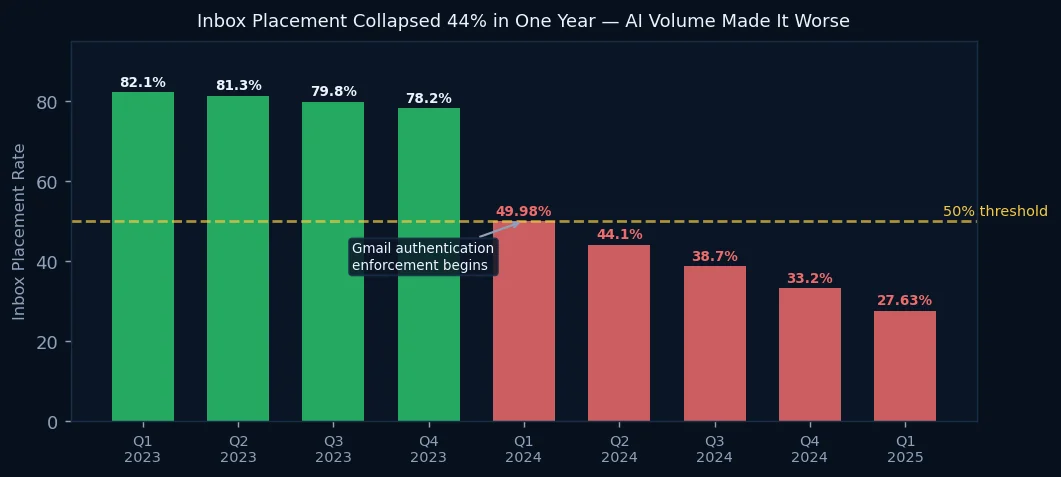
In Q1 2024, the average inbox placement rate for commercial email senders was 49.98 percent.
By Q1 2025, it had fallen to 27.63 percent.
That is not a rounding error. That is a collapse. Over the course of twelve months, more than half of all commercial email sent by legitimate businesses — authenticated, compliant, not spam — stopped reaching the inbox.
And artificial intelligence, the technology that was supposed to make email marketing better, is one of the primary reasons it happened.
How Authentication Requirements Broke Everything
The collapse did not arrive without warning. Gmail began enforcing strict email authentication requirements in November 2023, demanding that all senders of more than five thousand emails per day implement DMARC, DKIM, and SPF records properly or face automatic rejection. Microsoft followed in May 2025. Yahoo implemented parallel requirements.
These requirements were reasonable. Authentication makes it harder to spoof sender identities and enables mailbox providers to build sender reputation models with more confidence.

But authentication was only the first layer. The second layer — the one that is actively damaging legitimate senders in 2026 — is semantic filtering powered by AI.
Gmail's Gemini integration introduced content-level analysis that operates independently of authentication. A sender can pass every technical authentication check, maintain a spotless domain reputation, and still be deprioritized or filtered based on the content of the email itself.
The specific problem: mailbox providers trained their AI filters on enormous datasets of spam. Those datasets now include vast quantities of AI-generated spam — because AI made spam trivially easy to produce at scale. The filters learned to recognize the patterns of AI-generated text.
Now, when legitimate senders use AI to write their email copy, those emails trigger pattern matches in filters trained on AI-generated spam.
The AI that writes your email and the AI that filters your email are in an arms race. And right now, the filters are winning.
The Measurement Collapse Nobody Is Talking About
Here is where the story becomes genuinely strange.
Most email marketing teams are measuring the wrong things. Open rate has been the primary metric for email marketing effectiveness for two decades. And open rate is now, functionally, meaningless.
Apple's Mail Privacy Protection, introduced in 2021, began prefetching email content — causing all emails opened in Apple Mail to register as opened, regardless of whether the recipient actually read them. Apple Mail accounts for approximately forty percent of email opens in the United States.
Gmail's AI now hides engagement signals entirely for emails it routes to secondary folders or promotions tabs.
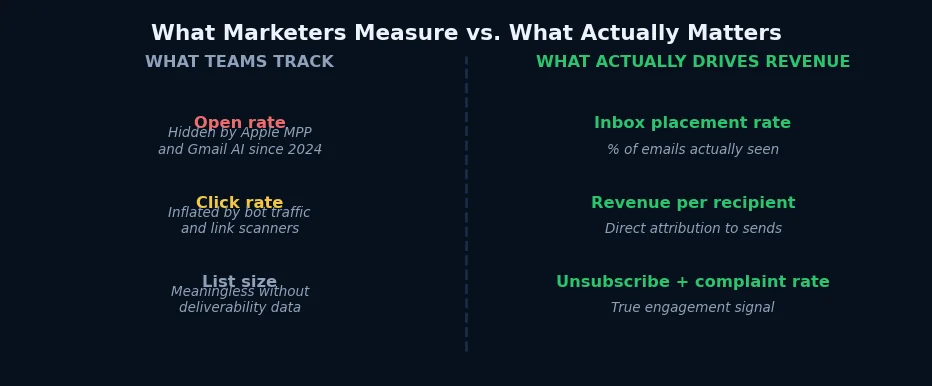
The result: open rate data in 2026 is a composite of real opens, Apple prefetch phantom opens, and missing Gmail opens — producing a number that correlates poorly with actual recipient engagement.
Yet most marketing teams, most marketing dashboards, and most email vendor reporting interfaces still present open rate as the primary success metric.
This creates a dangerous feedback loop. AI systems optimizing for open rates are optimizing for a metric that does not reflect reality. They generate more emails — because volume appears to drive opens — without recognizing that higher volume is simultaneously accelerating deliverability degradation.
The teams that are winning in email in 2026 are the ones that have quietly replaced open rate with revenue per recipient and inbox placement rate as their primary success metrics. Both are harder to measure. Neither is reported prominently by major email platforms. Both reflect actual outcomes.
Why AI Specifically Made This Worse
The arms race between AI email generation and AI spam filtering accelerated a trend that had been building gradually for years.
Prior to 2023, producing spam at scale required either human labor or relatively crude text generation tools. Spam had recognizable characteristics — grammatical errors, awkward phrasing, generic content — that filters could identify.
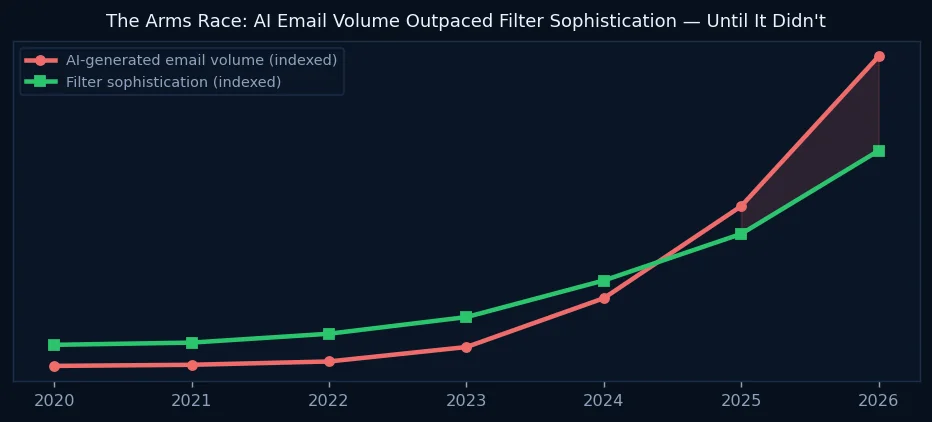
Modern AI-generated email has none of these characteristics. It is grammatically correct. It sounds human. It is contextually appropriate. And it can be produced at essentially zero marginal cost.
The result: every bad actor with an API key can now generate unlimited quantities of sophisticated, convincing spam. Mailbox providers responded by training their filters on the new generation of AI spam — and those filters cannot reliably distinguish between AI-generated spam and AI-generated legitimate marketing.
Both read the same. Both trigger the same signals. Both land in the same place.
The companies most aggressively using AI to scale their email programs are, in many cases, unknowingly accelerating their own deliverability degradation.
What Actually Works Now
The counterintuitive finding from email senders who have maintained strong deliverability through this transition: less is more, and human signals are gold.
Sending to smaller, more engaged lists consistently outperforms sending to large, cold lists — even when the cold lists are AI-segmented and AI-personalized. Mailbox providers weight engagement signals heavily, and engagement signals from genuinely interested recipients are impossible for AI to fake at the filter level.
Plain-text emails — or emails with minimal HTML — outperform heavily designed templates in inbox placement, because the formatting patterns of designed emails increasingly overlap with the patterns of sophisticated spam.
The teams seeing the best results are treating email not as a volume channel but as a high-trust, low-frequency relationship channel. They send fewer emails. They segment more aggressively. They measure revenue attribution directly rather than open rates.
This is not the direction most AI email tools are pushing their users.
Most AI email tools are pushing higher volume, more automation, and more personalization at scale — the exact combination that is degrading deliverability across the industry.
The Uncomfortable Question
The email marketing industry sold AI as the solution to email's performance problems: better personalization, better subject lines, better send-time optimization, better segmentation.
None of that is wrong. AI can genuinely improve each of those things in isolation.
But the industry did not adequately account for the systemic effect of all its customers simultaneously deploying AI-generated volume against mailbox providers who were simultaneously deploying AI-powered filters trained on AI-generated spam.
The result is a channel that is measurably less effective than it was eighteen months ago — not because email stopped working, but because the industrial application of AI to email creation created a negative externality that individual senders did not internalize.
Every sender using AI to scale volume made the channel slightly worse for every other sender.
This is not a technical problem with a technical solution. It is an economic problem — a tragedy of the commons playing out inside a communication channel that four billion people use daily.
The solution is not to use less AI. The solution is to use AI differently — to understand recipients better and send less, rather than to understand recipients adequately and send more.
That reorientation has not yet arrived at most marketing organizations.
When it does, the teams that made it first will have a significant and durable advantage.