
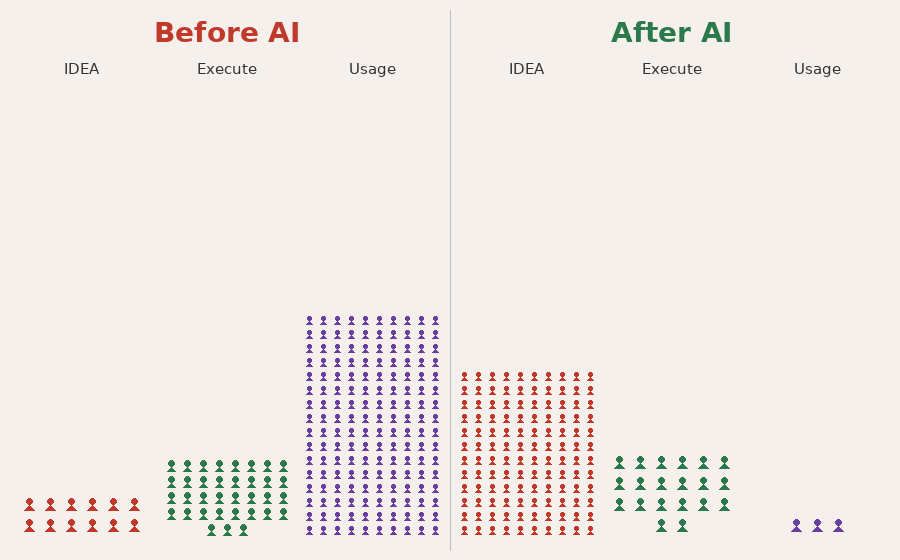
There's a chart circulating right now that reframes the entire AI market debate in a single image. It compares three columns — Idea, Execute, Usage — before and after AI, represented by human figures.
Before AI: a handful of people with ideas, a slightly larger team to execute them, and a massive user base consuming the result. The bottleneck was always execution: can you actually build the thing?
After AI: the idea column explodes. Everyone has ideas now, and AI lowers execution cost dramatically. But the Usage column collapses to almost nothing. Infinite products, limited attention.
What This Means for Markets
This isn't just a productivity observation — it's a valuation framework.
Pre-AI, the market rewarded execution capability. Hiring engineers, building infrastructure, shipping product fast — these were the moats. That's why enterprise software traded at a premium. Snowflake, Salesforce, Workday: you were paying for the hard part of building.
Post-AI, execution becomes table stakes. The new scarce resource is attention and distribution. Which companies own the Usage column?
- Meta, Google, Apple, Amazon — they control the pipes through which users discover everything. Their moat widens as product supply floods.
- Pure SaaS middleware — at risk. If AI can generate a competitor in a weekend, what's the defensibility?
- Marketplaces with network effects — more durable. The supply/demand matching is the product, not the software itself.
The Algo Trading Angle
For systematic traders, the implication is straightforward: the AI winners are not the companies building the most impressive models. They're the ones who own distribution to the end user.
This is already playing out in valuations. The market is starting to price distribution moats at a premium over pure AI capability — which is why Microsoft's partnership with OpenAI matters less than the Teams/Azure user base backing it.
Watch the Usage column. In the post-AI economy, whoever owns the eyeball wins the revenue — regardless of who built the best model.
The Contrarian Read
One legitimate pushback: the Usage column may not stay small. Historically, transformative technology expands the total addressable market rather than fragmenting a fixed pool of attention. Radio didn't shrink books. Mobile didn't kill desktop.
If AI genuinely unlocks new categories of demand — agents running autonomously, tools for populations that had no access to software — then the funnel inverts again. The current "attention scarcity" framing assumes a fixed user base dividing attention. If the base expands, the chart looks different.
That uncertainty is what makes this the central positioning debate for the next decade.