
For the last two years, artificial intelligence felt almost magical.
A prompt and suddenly there was code, strategy, research, design, automation, and possibility.
Many of us discovered something that felt dangerously close to a superpower.
I know I did.
Late nights turned into early mornings. Coding projects multiplied. Ideas that once required teams or weeks of effort could suddenly be built by one person sitting behind a laptop and an API key. The gym turned into a continuous coding session. And don't even get me started about driving. Coding while behind the wheel. Voice prompting at red lights. Ideas that couldn't wait for a parking spot. Sleep became negotiable. The feeling was intoxicating.
Not because AI replaced human ambition.
Because it amplified it.
But beneath this explosion sat an uncomfortable truth:
Much of modern AI has been subsidized.
The world became accustomed to frontier intelligence at prices that may never have reflected its true cost.
Now that era may be ending.
And surprisingly, that might be a good thing.
The Subsidized Superpower
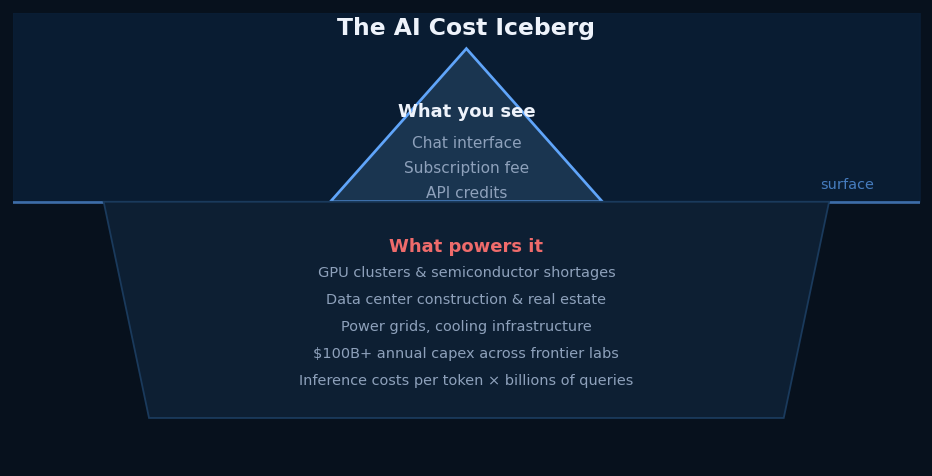
Most people experienced AI through chat interfaces and subscriptions.
What they rarely saw was the industrial machinery underneath.
Data centers.
Power grids.
GPU shortages.
Inference clusters.
Cooling systems.
Massive capital expenditures measured not in millions but in tens and hundreds of billions.

The economics were temporarily hidden.
Companies competed aggressively for users, developers, and market share. Tokens became cheap, bundled, or effectively subsidized in pursuit of scale and dominance.
That strategy made sense.
The AI race was—and remains—part technological revolution and part land grab.
But subsidies create distorted behavior.
When something appears almost free, people use more of it than they otherwise would.
Sometimes productively.
Sometimes wastefully.
We are beginning to see that distinction emerge.
Recent announcements and policy shifts from major corporations increasingly suggest that unrestricted AI consumption may not remain the norm forever. Large enterprises are beginning to ask harder questions about token budgets, compute efficiency, and whether AI usage is producing measurable value rather than simply generating activity.
The problem was never intelligence.
It was economics.
Cheaper prompts did not necessarily mean cheaper outcomes.
The Token Reckoning
The original narrative around AI was simple:
AI lowers labor costs.
But another narrative is now appearing:
AI may lower labor costs while simultaneously increasing compute costs.
This matters.
Because the AI economy ultimately runs on inference.
And inference costs money.
A lot of it.
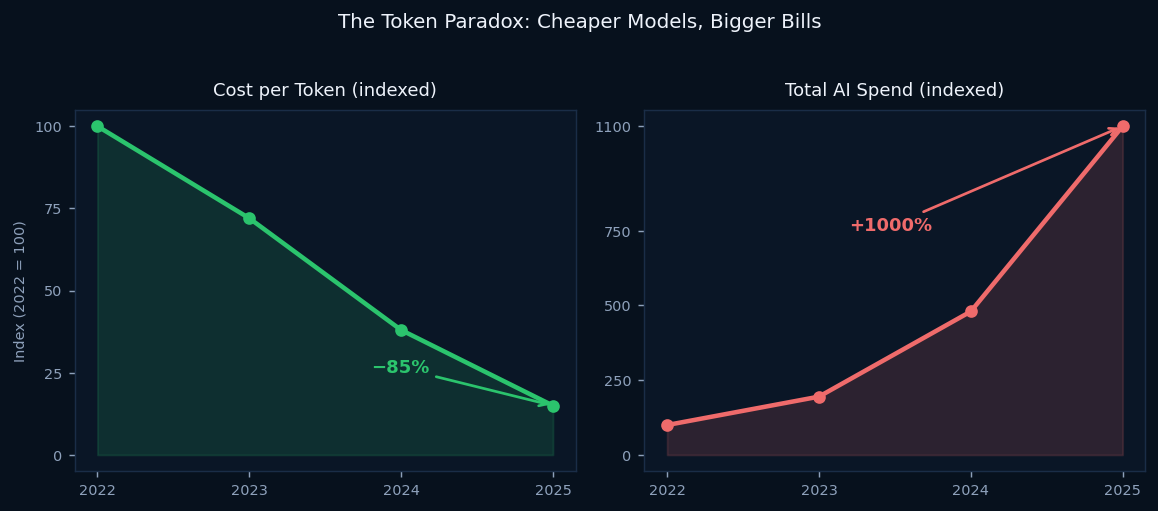
Even as model prices have fallen dramatically in some categories, total spending has often risen because usage exploded faster than efficiency improved—a classic rebound effect.
The more capable AI becomes, the more people ask of it.
And the more agents operate autonomously, the larger the token bill grows.
This creates a paradox.
AI became cheaper. Yet AI bills became larger.
That paradox is forcing a rethink across the industry.
Not because AI failed.
Because it worked too well.
Recent decisions by large corporations to place more controls around AI usage, token spending, and deployment budgets should not necessarily be viewed as anti-AI sentiment. In many cases, they may simply reflect the beginning of financial discipline entering the AI era.
That discipline matters.
Because public markets, enterprise buyers, and shareholders eventually ask the same question:
Where is the return?
China Changes the Equation
The pricing debate becomes even more complicated when viewed internationally.
Chinese model families have increasingly pursued aggressive pricing, discounting, and heavily competitive deployment strategies.
This introduces a strategic dilemma.
American frontier labs operate under enormous compute and infrastructure costs while simultaneously preparing for public markets and investor scrutiny.
Chinese competitors, meanwhile, often prioritize scale, ecosystem capture, and strategic positioning.
The result resembles previous industrial contests.
Not merely a technology race.
A pricing war.
And pricing wars are rarely gentle.
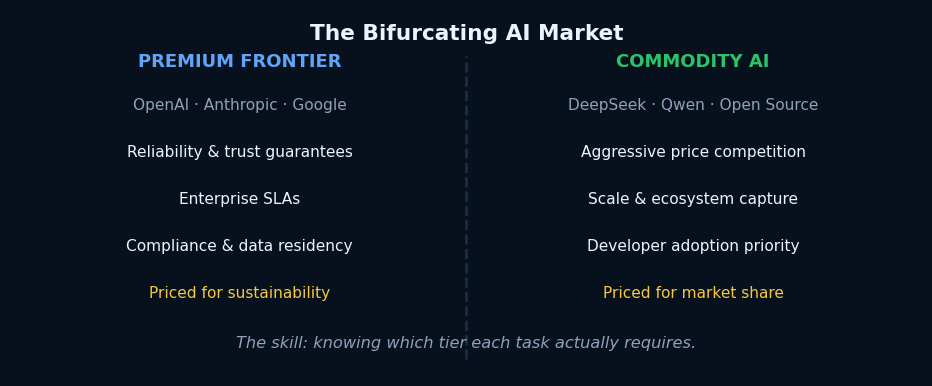
The consequence may be a bifurcated AI market:
Premium frontier intelligence priced around reliability, capability, and enterprise trust.
And ultra-cheap or heavily discounted intelligence competing on accessibility and scale.
That competition could reshape developer behavior, enterprise procurement, and even national technology policy.
IPO Pressure Changes Everything
Timing matters.
And the timing here is difficult to ignore.
Anthropic's public-market ambitions, growing IPO speculation surrounding OpenAI, and the broader fascination with potential offerings like SpaceX all arrive at a moment when investors are asking harder questions about monetization, infrastructure costs, and long-term sustainability.
Public markets ask different questions than venture capital.
VC money often asks: How fast can you grow?
Public markets ask: Can this generate durable cash flow?
That distinction matters enormously.
The era of growth at any cost becomes harder when investors begin modeling power consumption, GPU procurement, infrastructure depreciation, and token economics.
IPO markets do not merely price innovation. They price sustainability.
And sustainability may become the next major AI battleground.
The Computer Shortage Nobody Wants to Talk About
AI enthusiasm also collides with physical reality.
Compute is not infinite. GPUs are not infinite. Electricity is not infinite.
Power, cooling, and semiconductor capacity increasingly look like strategic infrastructure rather than ordinary technology inputs.
This is where AI begins to resemble energy economics.
The real bottleneck may not be intelligence.
It may be power.
And power shortages force prioritization.
Not every prompt deserves frontier reasoning.
Not every task requires a digital genius.
That realization may feel disappointing.
It should not.
Scarcity often improves decision-making.
Why Usage-Based AI Could Be Healthier
There is an uncomfortable possibility here.
Maybe unlimited AI was never healthy.
Not economically. Not environmentally. And perhaps not psychologically.
I say this personally.
AI unlocked extraordinary productivity for me.
But it also made it easy to stay up until three or four in the morning chasing endless projects.
Build this. Test that. One more prompt. One more system. One more impossible idea suddenly made possible.
The feeling was intoxicating because for the first time, intelligence itself felt programmable.
Some of those projects mattered. Many did not.
That realization matters.
Because the danger of powerful tools is not only misuse. It is overuse.
When friction disappears entirely, judgment often disappears with it.
And maybe that is where the token debate becomes more than an economic conversation.
It becomes a philosophical one.
AI was never supposed to be about burning tokens for sport.
It was supposed to create leverage. Efficiencies. Time savings. Better decisions. New revenue opportunities.
Why Private Equity Gets This Right
That philosophy shaped much of how we approached building with AI.
And it is why some of our most meaningful work has been with private equity firms and performance-driven operators.
Private equity thinks differently about technology than most.
In venture-backed environments, AI adoption is often driven by narrative. The question becomes: how much AI are we using? Adoption metrics replace outcome metrics. Deployment becomes a story told to investors rather than a tool measured against results.
Private equity does not have that luxury.
PE operates under a different clock. Funds have defined timelines. Portfolio companies have EBITDA targets. Partners have capital at risk and returns to deliver. There is no room for technology theater.
When we work with PE-backed operators, the conversation is fundamentally different.
It is not: "Can you build us an AI dashboard?"
It is: "We have a portfolio company losing three hours per analyst per day on manual data reconciliation. Can AI fix that and what does it cost to implement versus the labor savings?"
That precision changes everything.
It forces a rigorous answer to the question most AI vendors never want to address: what is this actually worth?
We have helped PE firms and their portfolio companies compress due diligence timelines, automate reporting workflows, build custom operational intelligence systems, and replace manual processes that were quietly consuming capital at every level of the stack.
The work that matters is rarely glamorous.
It is usually unglamorous, specific, and financially measurable.
A portfolio company that saves forty hours per week of analyst time at a fully loaded cost of $85 per hour generates over $175,000 in annual labor value. The AI infrastructure to produce that result might cost a fraction of that to build and maintain.
That math is not theoretical.
It is the kind of ROI calculation that private equity operators understand immediately—because they think in those terms every day.
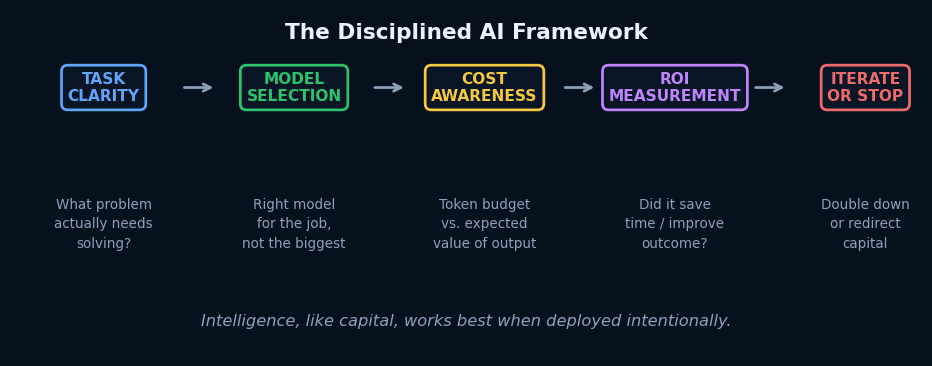
The mindset that makes PE operators such strong AI partners—rigor, specificity, measurability—may prove increasingly valuable as token subsidies fade and compute becomes more expensive.
Because AI layered onto a process without purpose quickly becomes an expensive distraction.
When building custom systems, we understand the infrastructure budgets involved, the costs of cloud providers, and the operational realities behind digital transformation. AI has to justify its existence.
That does not mean experimentation is wrong.
Quite the opposite. Experimentation is essential. Curiosity built this industry.
But experimentation without direction can become its own form of excess.
The Discipline of Model Selection
Part of AI maturity may also involve becoming more sophisticated consumers of intelligence itself.
Many developers and businesses still default directly to the most powerful frontier models without fully understanding the economics behind that decision.
That approach made sense during the subsidy era.
But the next phase of AI may reward a different skillset:
Knowing the token economics of major labs. Understanding inference costs. Knowing when frontier reasoning is truly necessary—and when it is not.
The reality is that much of the market still gravitates toward the largest American frontier systems while never seriously exploring the rapidly evolving landscape of alternatives.
Chinese model families. European initiatives. Open-source ecosystems. Smaller specialized models. Distilled reasoning systems.
This is not a political argument or a statement about superiority.
It is an economic one.
Not every task requires premium intelligence. Sometimes the best model is not the most famous one. It is the one that delivers the required outcome at the right cost and speed.
That may become one of the defining operational skills of the next AI era.
Model selection. Cost awareness. Inference discipline.
Just as companies learned to manage cloud spending rather than treating infrastructure as unlimited, AI users may need to learn the economics of intelligence.
The healthiest AI development may ultimately be ROI-driven development.
Not because creativity should be restricted.
But because intelligence, like capital, works best when deployed intentionally.
That is why usage-based economics may not be a punishment.
It may be a correction.
Pricing creates prioritization. Prioritization creates discipline. And discipline creates better outcomes.
The goal was never to build infinite things.
The goal was to build meaningful things.
A More Mature AI Era
This is not the death of AI.
Far from it.
AI may become more valuable than ever.
But the next phase may look less like a digital gold rush and more like industrial infrastructure.
Less novelty. More accountability. Less token-maxxing. More intentional deployment.
That may disappoint some people.
I think it signals maturity.
The free lunch was extraordinary while it lasted.
But perhaps the real future begins once we stop pretending it was free.