
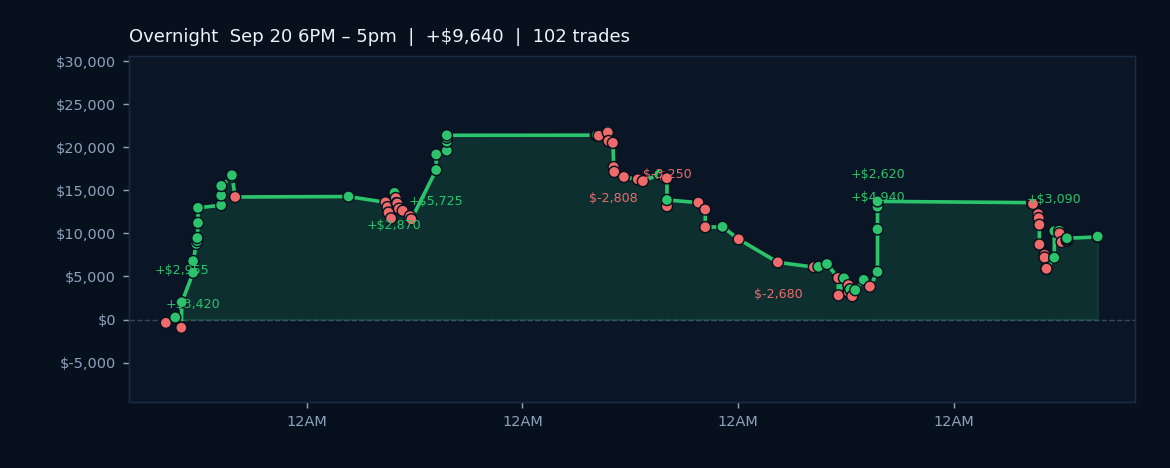
The week of September 21-25 delivered a sobering lesson in regime navigation. Across four trading days and 84 total trades, the platform posted a net loss of $4,590.00, though the cumulative year-to-date P&L remains solidly positive at $183,543.11. The win rate settled at 41.7%, a clear headwind, with gross profit of $34,436.25 unable to offset gross losses of $39,026.25, yielding a profit factor of 0.88. The volatility within the period was acute: Monday, September 21 marked the week's brightest moment with a gain of $7,162.50, while Tuesday's reversal produced the period's deepest drawdown at $7,506.25 in losses, a two-day swing that underscores the difficulty of maintaining consistency in choppy price action.
The AI Regime's 100% confidence reading of "chop" proved an accurate lens for the week's character. In regimes lacking directional conviction, edge compresses and execution timing becomes everything. The platform's loss rate reflects precisely this dynamic: market structure was fragmented, entries lacked the clean setup quality that higher-win-rate weeks typically feature, and the tail risk of whipsaw trades accumulated. AI Pi sits at 59.5%, hovering near neutral, while sentiment has turned negative, further depressing the signal quality that the algos depend on for reliable fills and follow-through.
The active AI recommendations point toward tightened discipline as the corrective mechanism. Two simulations are now flagging daily loss limits (around $1,715 and $1,230 respectively) and blocking the weakest intraday entry buckets—morning and early-afternoon time windows that historically leak capital in choppy conditions. These constraints, if enforced, would have cushioned this week's drawdown and forced earlier exits from low-conviction setups. Over time, this filter-layer approach trades raw trade count for quality, a recalibration that chop regimes demand.
Looking ahead, seasonality presents a contrarian signal. From this point in midterm-election years, the S&P 500 has averaged +1.13% with a 58% win rate over the next trading week (n=19 years), a marked outperformance relative to the all-history baseline of +0.18%. While the regime filter remains locked in chop and sentiment is negative, the historical seasonal pattern suggests ES could find directional conviction sooner than current market structure implies, setting up a potential regime shift that tighter entry discipline would be well-positioned to capture.