
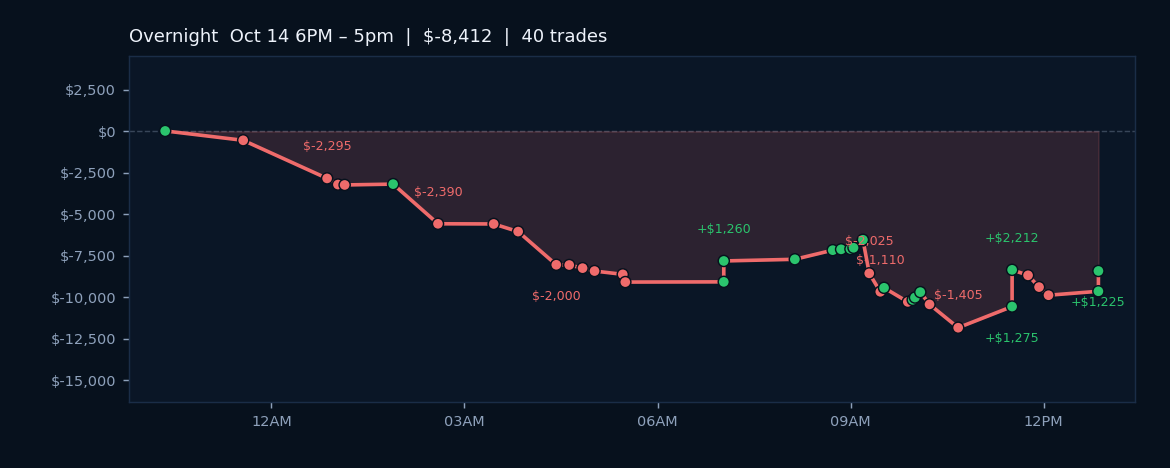
The session produced a -$8,412.50 drawdown, reducing cumulative total P&L by -4.00% to $201,980.94. Across 40 trades, the algos managed a 47.5% win rate (19W / 21L) with a 0.5 profit factor, indicating substantially higher average loss size relative to gain. Gross profit totaled $8,405.00 (33.3% of gross activity) against gross losses of -$16,817.50 (66.7%), yielding an average winner of +$442.37 and average loser of -$800.83. The imbalance reflects execution friction typical of confined, sideways price action.
Equity index futures remained range-bound throughout the session. ES held above the prior-day close of 7786 but struggled to sustain directional momentum, with the overnight high at 7789.5 proving resistant. NQ similarly clung to technical anchors near its prior-day close of 30078.2, while the micro Russell 2000 contract (RTY) traded narrowly around 2782.6. The AI Regime is reading full-strength chop at 100% confidence, a structural headwind for directional mean-reversion and breakout logic alike. Intraday volatility remained muted despite a heavy macro calendar: Core PPI, Core Retail Sales, headline PPI, and Retail Sales all printed today alongside remarks from Fed Chairman Warsh, yet price discovery remained constrained.
The AI recommendation stack has flagged structural vulnerabilities requiring attention. [Sim101ES813C] enforces a daily loss limit near $1,715.00, with current max drawdown standing at $12,175.00, while a parallel instance targeting weak entry buckets recommends blocking trades during 08:30, 13:00, 10:10, 04:05, and 15:30 UTC buckets on the basis of negative average PnL clustering. A second algorithm suite ([SimES813CEDGE NS]) mirrors this discipline, suggesting a $1,230.00 daily cap and filtering time windows including 03:05, 07:05, 15:05, 03:35, and 06:35 UTC.
Looking ahead, AI sentiment remains positive and AI Pi stands at 62.5%, yet the regime filter's chop reading will likely persist through the remainder of the week. Seasonality data from midterm-year Octobers (1950-2026) suggests the coming trading week has historically averaged +0.90% with a 63% win rate (n=19 years), a structural tailwind that may reward disciplined position-sizing and tighter entry discipline once the regime gradient clarifies.