
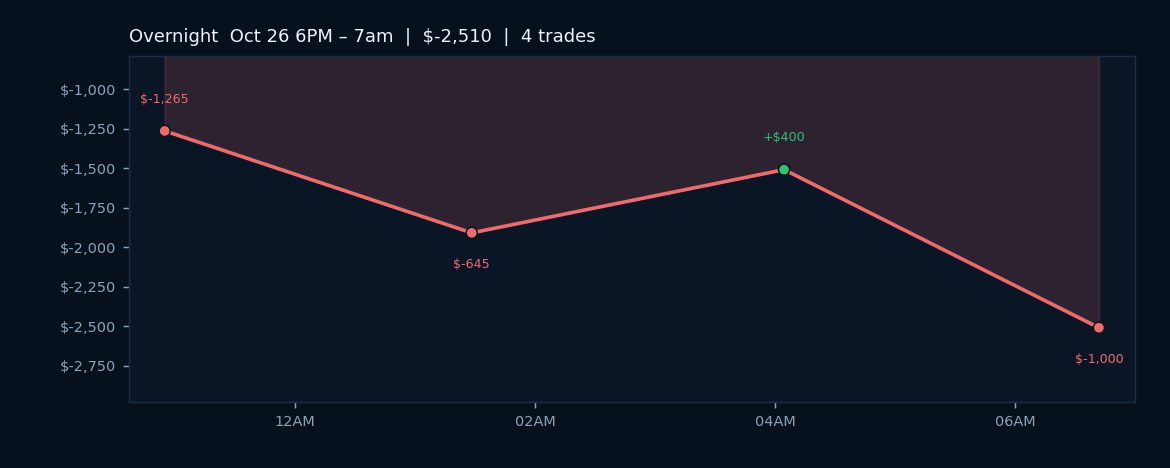
Overnight session delivered a $-5,770 net loss across seven ES and NQ trades, posting a 28.6% win rate as volatility pushed several scalp positions through their stops ahead of today's open. The pre-market tape reflects caution heading into tomorrow's Federal Funds Rate decision and FOMC statement, where the market expects the Fed to hold at 4.00% while digesting the implications of recent inflation and employment data. Geopolitical headlines have stacked up overnight: Iran's Khamenei and senior officials are discussing Hormuz management and preconditions for de-escalation, while Yemen's Houthis launched attacks on Saudi refinery infrastructure and Russia signaled willingness to reroute gas flows if Europe continues to reject energy agreements. These cross-currents are setting a cautious tone, though equity index futures remain supported by seasonal tailwinds and a positive sentiment reading.
The earnings calendar kicks into gear this week with PayPal and Coca-Cola reporting this morning, followed by the heavyweight tech double of Microsoft and Google tomorrow. Amazon, Apple, and AMD round out the major names scheduled for later in the week. The overnight loss reflects the market's struggle to find clean directional conviction ahead of both the Fed call and tech guidance, as traders hedge positions in anticipation of potential volatility swings tied to both monetary policy and Q3 guidance from mega-cap growth stocks. Seasonality data favors the next trading week (midterm years since 1950 averaged +0.63% with a 68% win rate), though that historical edge carries no guarantee in a session consumed by Fed risk.
Current open positions remain on the long side: two scalp contracts in ES and NQ are holding unrealized gains of $575 and $4,470 respectively, while a separate ES position is underwater by $212. AI Regime is reading trend at 100.0% confidence with overall sentiment sitting positive, and AI Pi stands at 51.9%. The algorithm stack is executing according to its fixed RSI filters and ATM stop/target templates with no discretionary adjustments; as orders arrive and price action develops, the regime filter will govern entry and exit logic independent of Fed headlines, earnings surprises, or Middle East developments.