
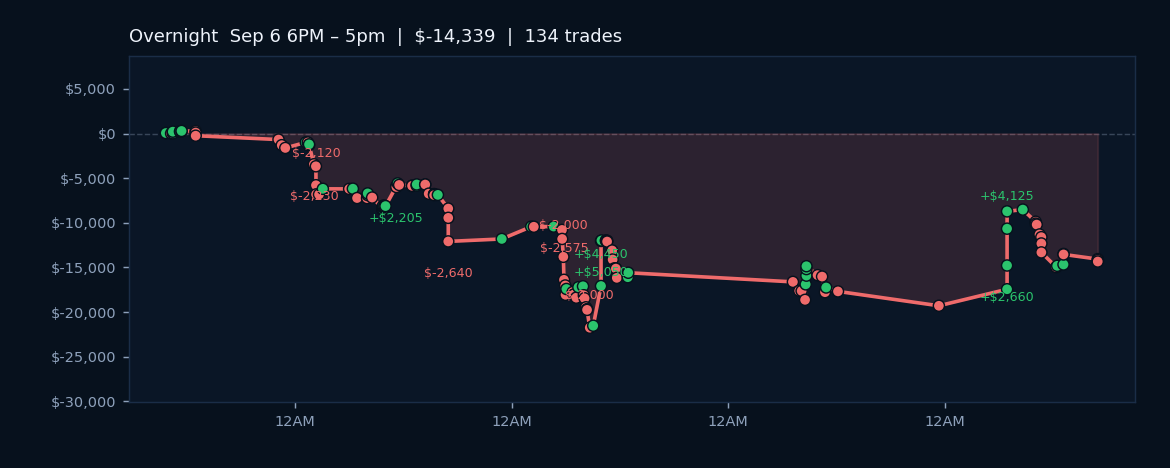
The week of September 7-11 closed with a net loss of $14,091.80 across 122 trades, marking a challenging period in which our execution struggled to keep pace with market conditions. Win rate landed at 33.6%, well below our target, while the profit factor of 0.72 signals that losing trades outpaced winners by a meaningful margin. Gross profit of $35,659.98 was overwhelmed by gross losses of $49,751.78, a mismatch that underscores the difficulty of navigating the current environment. The best single session came Thursday, September 10th, with a $3,345.00 gain, yet this was dwarfed by Monday's $11,838.77 drawdown, which set a challenging tone for the remainder of the week.
The AI Regime remained locked in high_vol territory at 100.0% confidence, a state that typically widens stop-loss triggers and reduces edge on mean-reversion strategies. AI Pi held steady at 56.8%, below neutral, while AI Sentiment tilted negative across the period. Under these conditions, the four-day window proved structurally hostile to our technical entry buckets. The algorithmic recommendations surfaced by our risk engine are particularly acute: daily loss limits near $1,715 (Sim101ES813C) and $1,230 (SimES813CEDGE NS) are now being flagged as necessary guardrails, given maximum observed drawdowns of $12,175 and $10,400 respectively. Weak entry time buckets, notably 08:30, 13:00, and 10:10 across our primary models, are generating persistent negative average payoffs and warrant continued blocking.
Looking ahead to the coming week, seasonality data from S&P 500 history (1950-2026) suggests caution: the next five trading days in midterm-year cycles have averaged -0.73% with a 47% win rate across nineteen comparable periods, materially weaker than the all-time baseline of +0.18%. This mixed seasonal reading, combined with the regime's persistence in high volatility and AI Sentiment remaining negative, suggests continued pressure on entry quality and capital preservation over growth through the near term.