
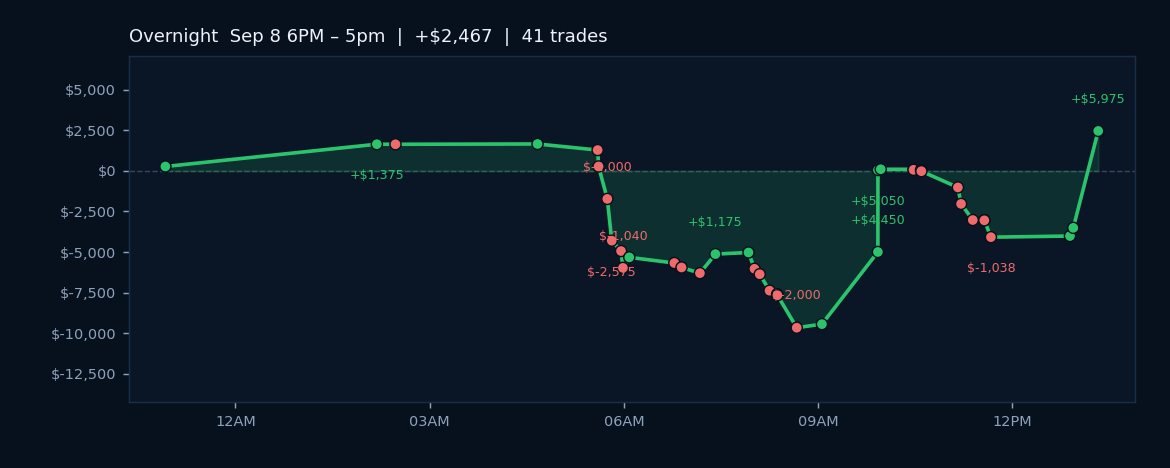
The algos grew by +1.46% on the day, extending cumulative total P&L to $171,241.12, though session execution revealed the friction inherent in choppy, high-volatility regimes. Across 41 trades, the strategy managed a 31.7% win rate with 13 wins against 28 losses, producing $19,913.75 in gross profit offset by $17,446.27 in gross loss for a 1.14 profit factor. The average winner ran $1,531.83 while the average loser was clipped at $623.08, underscoring disciplined stop-loss management even as directional conviction remained elusive. ES held above the prior-day high of 7691.25 during overnight hours, though the opening range (7663.75 to 7651.75) compressed into the prior-day close of 7648, signaling reluctant buyers ahead of tomorrow's Core PPI and PPI prints.
Japanese monetary policy dominated the macro backdrop: 97% of economists now expect the Bank of Japan to raise rates to 1.25% on September 18, a sharp revision from 57% just weeks ago, while 82% cite reduced political barriers for BoJ rate hikes following US Treasury chief Bessent's comments on joint FX intervention. Separately, geopolitical headlines from Iran and Israel (multiple blast reports in Qeshm and Sirik, Israeli military aircraft incursion later identified as misidentification) created surface noise without sustained directional impact on futures. Gold probed the overnight high of 4449.6 and held near the prior-day close of 4447.2, consistent with safe-haven demand; crude held between the overnight low of 96.79 and prior-day close of 96.67, betraying energy market indecision.
The AI Regime remains locked in high_vol with 100% confidence, while AI Sentiment reads negative and AI Pi sits at 55.0%, tilting slightly bullish but offering marginal conviction. Seasonality data flags a historical headwind: from this point in midterm-years, the next trading week averaged -0.85% with only a 47% win rate across 19 years, a sharp departure from the all-history baseline of +0.18%. With CPI and producer inflation on deck and ADBE earnings due Thursday, regime volatility is unlikely to subside; the AI Regime filter and the weak entry bucket recommendations (blocking 08:30, 13:00, and 10:10 time slots) remain critical guardrails as the platform navigates the asymmetric risk profile ahead.