
The Regulatory Pressure Building Under Fintech's Surface
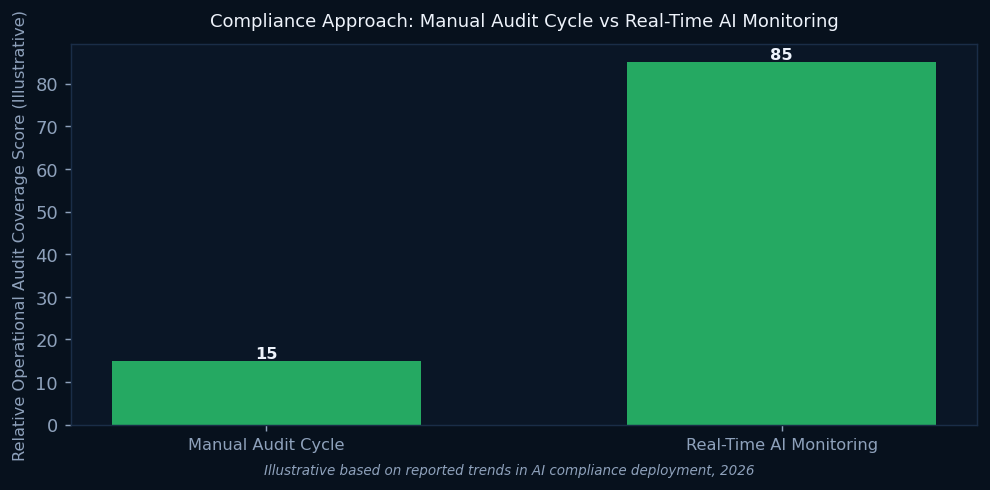
For fintech platforms, algorithmic trading desks, and wealth management operators, the compliance function has historically been a lagging process. Reports got filed after the fact. Audits happened on quarterly cycles. Regulatory breaches were often discovered weeks or months after the underlying behavior occurred. In 2026, that model is not just inefficient -- it is increasingly indefensible. Regulators across major jurisdictions are raising expectations for continuous monitoring, real-time recordkeeping, and demonstrable accountability at every layer of an organization's operations.
The pressure is structural, not cyclical. As fintech platforms scale their transaction volumes, diversify their product offerings, and operate across multiple regulatory frameworks simultaneously, the complexity of compliance grows non-linearly. A mid-sized algorithmic trading firm might touch securities law, anti-money laundering requirements, consumer protection regulations, and data privacy mandates all within a single trading session. Manual audit cycles cannot keep pace with that density of regulatory surface area.
This is precisely the moment when multimodal AI is stepping into a role that older compliance tooling simply cannot fill. The emerging generation of AI-powered compliance infrastructure is designed not to supplement human auditors on a quarterly basis, but to operate as a continuous, real-time monitoring layer embedded directly into operational workflows. The implications for how fintech platforms manage regulatory risk are significant -- and the competitive gap between early adopters and laggards is beginning to widen in ways that will be difficult to close later.
What Multimodal AI Actually Brings to Compliance
The term "multimodal AI" refers to systems capable of processing and reasoning across multiple types of data simultaneously -- structured transactional data, unstructured text, audio records, document images, and behavioral signals. For compliance specifically, this matters enormously. A traditional compliance system might flag a suspicious transaction by comparing a numerical value against a threshold. A multimodal system can correlate that transaction with a client communication record, a document submission, a voice call transcript, and a pattern of prior behavior -- all in real time.
This shift from single-signal to multi-signal analysis is what makes real-time compliance monitoring genuinely new, rather than just faster. The system is not simply automating what a human reviewer would do; it is synthesizing data relationships that a human reviewer could not realistically surface within a useful time window. For algorithmic trading platforms in particular, where thousands of decisions happen per second, the ability to audit behavior at the event level rather than the batch level represents a qualitative change in oversight capability.
Ncontracts made this ambition concrete when it introduced Nquiry in May 2026, positioning the product as an AI-powered regulatory intelligence tool capable of delivering what the company called "defensible compliance answers in minutes." That framing -- "defensible" -- is analytically important. It signals a shift from compliance as internal risk management toward compliance as a documented, auditable record that can be presented to regulators or in legal proceedings. That is a higher standard, and achieving it requires AI systems that can not only generate answers but also cite the regulatory text and reasoning chain behind those answers.
Agentic AI and the Automation of Regulatory Workflows
Beyond answering compliance questions, the frontier is moving toward systems that can take autonomous action in response to regulatory signals. This is the domain of agentic AI -- systems that can execute multi-step workflows, not just generate outputs. In the compliance context, an agentic system might detect a pattern that triggers a suspicious activity threshold, generate a preliminary report, escalate it through a defined internal review chain, and log every step with timestamps and reasoning -- without a human initiating any of those steps.
MRI Software's launch of Agora Intelligence and Agora Orchestrator in June 2026 offers a concrete example of how this architecture is being deployed in adjacent sectors. The Orchestrator component is specifically designed for workflow execution, not just recommendations -- meaning it acts, not just advises. While MRI's deployment is focused on real estate operations, the architectural pattern is directly applicable to fintech compliance workflows. The separation between an intelligence layer (which interprets data and generates recommendations) and an orchestration layer (which executes actions based on those recommendations) is a model that compliance infrastructure teams should be studying carefully.
Oracle NetSuite's release of its 2026.2 update in July 2026, which delivered AI-powered enhancements across key industries, signals that embedded AI compliance and operational intelligence is becoming a baseline expectation in enterprise software, not a premium differentiator. As that baseline rises, fintech platforms still operating on manual audit cycles will find themselves at a functional disadvantage when interacting with regulators, auditors, and institutional partners who have come to expect documented, real-time audit trails.
The Trust Gap That Is Slowing Deployment
Despite the clear directional pressure toward agentic, real-time compliance systems, adoption is not uniform. The evidence suggests that organizations are hitting a specific wall: trust. A report highlighted by FutureCIO in August 2026 noted that organizations are holding back on scaling agentic AI specifically because of trust issues. This is not a vague concern about technology -- it is a precise problem with accountability. When an autonomous system makes a decision that results in a regulatory filing, a client flag, or an internal escalation, who is responsible for that decision?
For fintech operators, this question carries real legal weight. Regulators do not accept "the algorithm decided" as a compliance defense. The accountability must trace back to a human decision-maker or a governance structure that a human authorized. This means that agentic compliance systems must be designed with explicit human-in-the-loop controls at defined escalation thresholds, and those controls must themselves be auditable. The AI system is not replacing the compliance officer; it is operating under a governance framework that the compliance officer is responsible for designing and validating.
Deloitte's March 2026 analysis of how compliance leaders are navigating the age of agentic AI outlined three strategic moves for organizations facing this challenge. While the specific moves are framed as strategic guidance rather than data points, the existence of that guidance at that level of institutional seriousness reflects how central this governance question has become. Compliance leaders who treat AI deployment as a purely technical decision -- delegating it entirely to engineering teams -- are misunderstanding their own accountability. The governance architecture of a compliance AI system is itself a compliance matter.
Wealth Management as a Pressure Test for Real-Time Oversight
The wealth management sector offers a useful lens for understanding how these dynamics play out in practice. Future Market Insights' coverage of the AI-powered wealth management solution market in May 2026 reflects a broader pattern: the integration of AI into investment advice, portfolio monitoring, and client relationship management is accelerating, and with it comes an expanded surface area for regulatory scrutiny.
Wealth management platforms face a particularly acute version of the compliance challenge because their regulatory obligations span product suitability, fiduciary standards, disclosure requirements, and anti-fraud mandates -- all of which can be triggered by a single client interaction. A real-time compliance layer in this context needs to monitor not just transactions but communications, recommendations, and the relationship between the two. Did the advice given match the product ultimately executed? Was the client's risk profile appropriately considered at the moment of the recommendation? These are not questions that a quarterly audit can reliably answer from historical data; they require event-level logging at the moment of interaction.
For operators building or scaling wealth management platforms in 2026, the implication is that real-time compliance monitoring is becoming a prerequisite for regulatory credibility, not an optional enhancement. Platforms that can demonstrate continuous, documented oversight of the advice-to-execution chain will be better positioned in regulatory examinations, better insulated against enforcement actions, and better able to attract institutional distribution partners who conduct their own operational due diligence.
Building a Real-Time Compliance Architecture That Holds Up
For fintech operators and trading platform builders reading this as an operational challenge rather than a theoretical one, the architecture question is where strategy meets execution. Real-time compliance monitoring requires infrastructure decisions that are difficult to reverse: data pipeline design, logging standards, model governance protocols, and escalation workflow definitions all need to be built with the assumption that they will eventually be reviewed by a regulator or auditor who did not choose them.
The most defensible architectures in 2026 share several characteristics. First, they maintain an immutable audit log at the event level -- every data point ingested, every model inference generated, and every action taken by the system is recorded with a timestamp and a reasoning trace. Second, they separate the monitoring function from the execution function, so that the system detecting a potential compliance issue is architecturally distinct from the system that responds to it. This separation preserves the ability to audit whether the detection logic was functioning correctly, independently of whether the response was appropriate.
Third, and critically, they are designed for explainability. A compliance AI system that can identify a suspicious pattern but cannot articulate why it identified that pattern in terms that a human reviewer can evaluate is not producing defensible compliance outputs -- it is producing a black box that amplifies rather than reduces regulatory risk. The "defensible answers in minutes" framing from Nquiry's launch points directly at this requirement: the output of the system must be something a compliance officer can stand behind in front of a regulator.
What Compliance Leaders Should Do Right Now
The strategic posture for compliance leaders in fintech and algorithmic trading in mid-2026 is defined by a clear tension: the technology is ready to move faster than governance frameworks are prepared to accommodate. Organizations that push deployment speed without investing in governance design will create new categories of risk. Organizations that wait for perfect governance clarity before deploying anything will fall behind in operational capability and regulatory credibility simultaneously.
The path forward is phased and deliberate. Start with the monitoring and intelligence layer -- deploying AI systems that observe, log, and flag without taking autonomous action. This builds the data infrastructure and the internal confidence needed to eventually extend into orchestrated workflows. Use that initial deployment phase to define, in explicit terms, the escalation thresholds and human approval requirements that will govern the eventual agentic layer. Document those decisions as part of the compliance record itself.
Invest in the explainability infrastructure before it is demanded by regulators. If the system cannot today produce a clear reasoning trace for every flag it generates, that is a design debt that becomes more expensive to repay as the system scales. The competitive advantage in real-time compliance is not just in detection speed -- it is in the quality of documentation that speed produces. In regulatory examinations, in litigation, and in institutional due diligence, the organization that can produce a complete, timestamped, reasoning-linked audit trail for every compliance event is in a structurally stronger position than the one that cannot.