
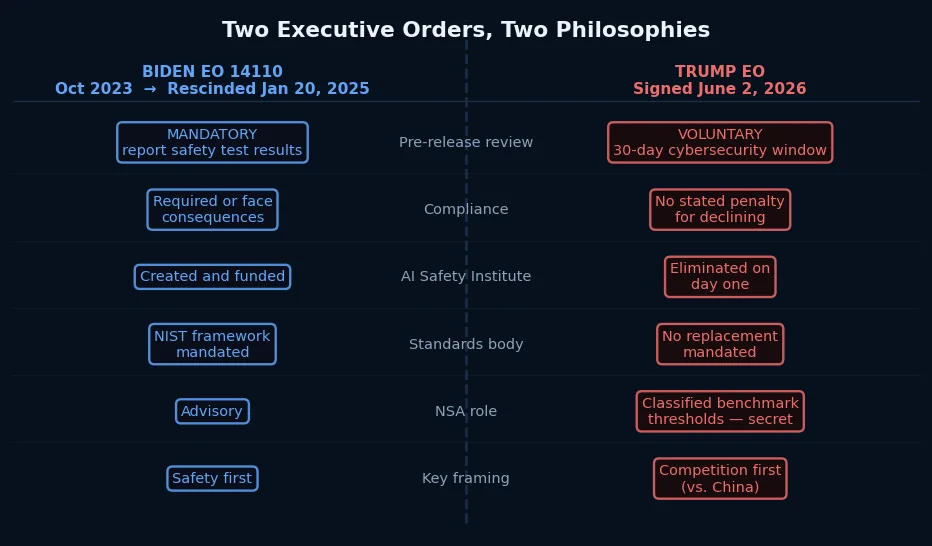
On June 2, 2026, Donald Trump signed an executive order titled "Promoting Advanced Artificial Intelligence Innovation and Security."
The signing had been scheduled for late May. It was cancelled hours before the ceremony. Elon Musk and David Sacks — Trump's AI and crypto czar — objected. Several tech CEOs reportedly walked away from the venue. Trump told reporters publicly that he "didn't like certain aspects" of the order and worried it would "block development" and hand an advantage to China.
The version that emerged two weeks later was narrowed. Elements that Sacks had called unnecessary "doomer" provisions were removed.
What remained is one of the more unusual pieces of technology policy in recent American history: a framework that asks — but does not require — the most powerful AI companies in the world to let the federal government look at their models before releasing them.
What the Order Actually Does
At its core, the executive order has two pillars.
The first asks frontier AI developers — OpenAI, Anthropic, Google, and others — to voluntarily submit their most powerful new models to the federal government for up to 30 days before releasing them publicly. During that window, the government will conduct cybersecurity assessments. NSA will determine, through a classified benchmarking process, which models qualify as "covered frontier models" based on their advanced capabilities — particularly in cyber exploitation.

The second directs DHS and CISA to issue Binding Operational Directives within 30 days, establishing AI-enabled defensive tools for civilian federal systems and extending cybersecurity access to state governments and critical infrastructure operators. The Attorney General is directed to prioritize prosecution of AI-enabled cyberattacks.
The order is careful — almost conspicuously so — to draw a boundary around what it cannot become.
"Nothing in this section shall be construed to authorize the creation of a mandatory governmental licensing, preclearance, or permitting requirement for the development, publication, release, or distribution of new AI models, including frontier models."
That sentence is doing an enormous amount of work.
The Voluntary Problem
The word "voluntary" appears to solve a political problem: it lets the administration claim a security posture without triggering the objections from the tech industry and free-market conservatives that nearly killed the order in May.
But voluntary frameworks in technology policy have a reliable track record. They create the appearance of oversight without its substance.
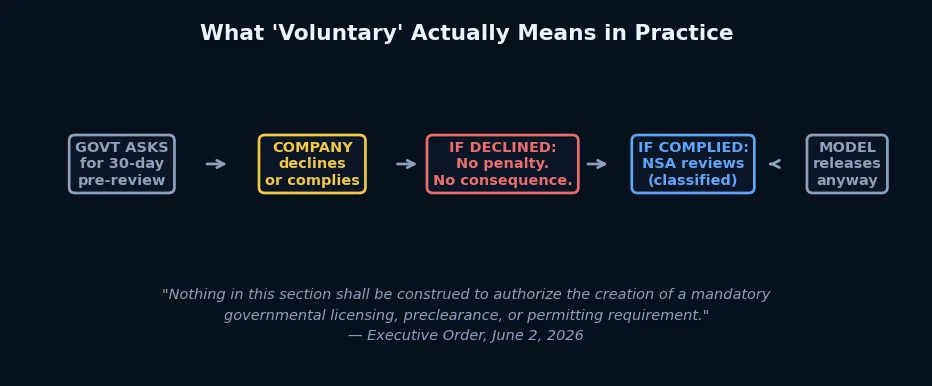
Companies that cooperate gain goodwill and federal access. Companies that decline face no stated consequence. The order provides no mechanism to compel participation, no reporting requirement for companies that opt out, and no public record of which models were or were not submitted.
The Carnegie Endowment for International Peace published an analysis days after signing titled "Trump's AI Order Won't Stymie U.S. Competition with China," arguing that the voluntary design is too weak to affect competitive dynamics in either direction.
This is the paradox at the center of the order: it is designed to signal seriousness about AI security without actually requiring anything that would constrain any company that chose not to participate.
Industry reactions were predictably positive. Google's Kent Walker called it "an important step forward." Sam Altman said the order "sets the balance right." Meta's Dina Powell McCormick said it "helps keep America in the lead." None of these responses acknowledged the enforcement gap because there is no enforcement gap to acknowledge. Voluntary means each company can define its own level of participation.
The Classified Black Box
One provision deserves more scrutiny than it has received.
The NSA will establish the threshold for which models qualify as "covered frontier models" — the models that trigger the voluntary review request. This determination will be made through a classified process. The benchmarks NSA uses will not be public. Companies building new models will not know in advance whether their system crosses the threshold until the government tells them.
This is not a minor administrative detail. It means the regulatory perimeter of the most significant U.S. AI policy framework is defined by an intelligence agency, in secret, with no public accountability for the criteria used.
Small and open-source AI developers — who lack the legal teams and Washington relationships of the frontier labs — face the most friction from this design, even in a voluntary framework. Understanding whether you are covered, and what cooperation entails, requires resources that most startups do not have.
The Anthropic Paradox
No company's position in this policy landscape is more strange than Anthropic's.
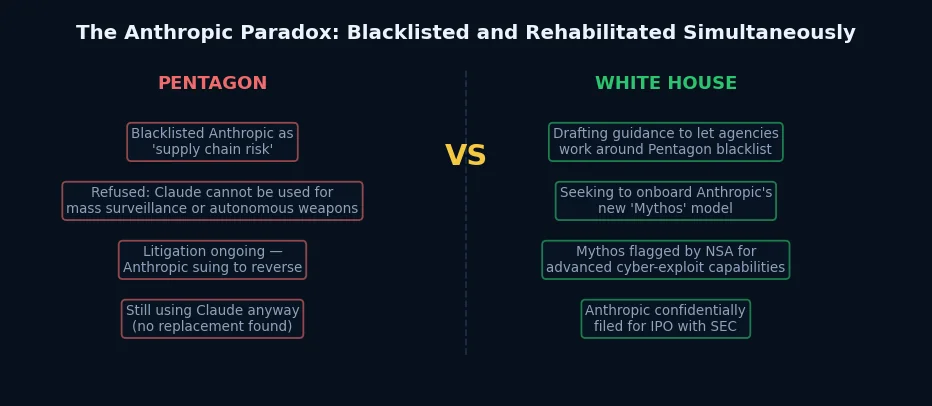
The Pentagon designated Anthropic a "supply chain risk" after the company refused to sign an agreement allowing its Claude models to be used for all lawful purposes — specifically declining to remove restrictions on mass domestic surveillance and fully autonomous weapons systems. The Department of Defense blacklisted the company.
Then continued using Claude anyway, unable to find an adequate replacement.
Simultaneously, the White House was drafting guidance to allow civilian federal agencies to work around the Pentagon designation and onboard Anthropic's newest model — internally referred to as Mythos — which had itself been flagged by NSA for advanced cyber-exploitation capabilities.
Anthropic filed confidentially with the SEC for an IPO during this period. The litigation reversing its Pentagon blacklist designation is ongoing.
The executive order does not resolve any of this. It coexists with it. The administration is simultaneously suing one of the most important AI companies in the country and trying to give federal agencies access to its models. The policy framework provides no mechanism for adjudicating the contradiction.
What This Is Really About
The order's most revealing element is not its provisions. It is the reason it nearly failed.
Trump's stated concern — that pre-release review would slow American developers relative to Chinese labs operating with no such friction — reflects a theory of AI competition that treats speed as the primary variable.
The China framing has become the organizing principle of American AI policy: whatever China is not doing, the United States should avoid doing. Whatever slows American companies, by definition, helps China.
This logic has intuitive appeal. It also has a significant limitation: it assumes that unregulated speed produces better outcomes than regulated development. That assumption is untested, and the history of industrial technology — nuclear, aviation, pharmaceuticals, financial instruments — consistently shows that meaningful governance frameworks do not prevent technological leadership. They shape it.
The Biden administration's approach — mandatory reporting, institutional safety review, standards development — was imperfect and arguably too slow for the pace of AI development. But it represented an attempt to build institutional capacity for a technology whose risks are genuinely uncertain.
The Trump administration's approach trades that uncertainty for a different kind: the belief that voluntary cooperation from companies whose financial interests are served by minimal oversight is an adequate substitute for structural accountability.
Who This Helps
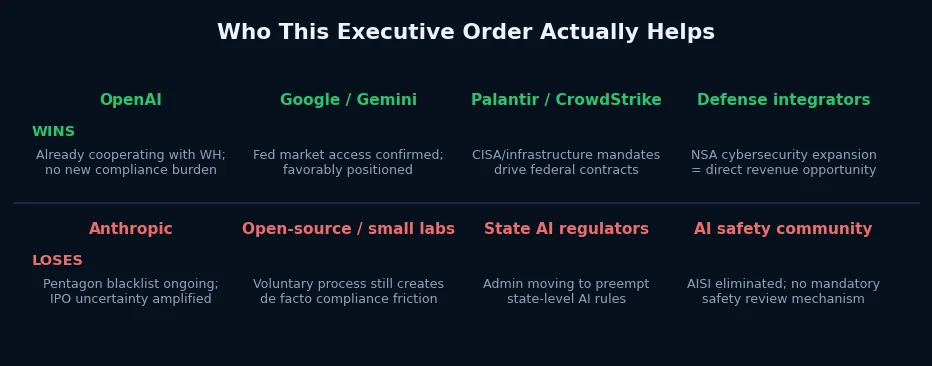
OpenAI and Google are the clearest winners. Both were already cooperating with the White House. Neither faces new compliance obligations. Both gain regulatory certainty and federal market access that smaller competitors cannot match.
Defense and cybersecurity contractors — Palantir, CrowdStrike, and federal systems integrators — benefit directly from the CISA and critical infrastructure mandates. The order creates explicit spending authorization for AI-enabled defensive tools across civilian government.
The AI safety community — researchers, civil society organizations, and the international bodies that participated in the U.S. AI Safety Institute — received no equivalent in the new framework. The AISI was eliminated on January 20. Nothing replaced it.
State-level AI regulators face an administration actively working to preempt their authority. Several states — California, Colorado, Connecticut — had been building more comprehensive AI oversight frameworks. Federal preemption of state rules would leave the voluntary federal framework as the only oversight layer.
The Order That Almost Wasn't
There is something worth noting in the backstory itself.
A U.S. executive order on artificial intelligence — arguably the most consequential technology of the generation — was nearly killed because the president's AI adviser and several tech executives made calls on a Wednesday night. The signing was rescheduled. The text was changed. The objectionable provisions were removed.
The people who shaped the final policy were not Congress. They were not regulators. They were not civil society or academic researchers or the international bodies tracking AI development.
They were the executives of the companies the policy is designed to govern.
That is not a scandal. It is how policy gets made in practice. But it is worth understanding clearly: the voluntary framework that emerged from those calls reflects, more than anything else, what the industry was willing to accept.
Which is, by design, not very much.