
At some point in the next twelve months, a brand is going to face a significant legal or regulatory action because their AI marketing system said something factually wrong about their product.
The brand will be surprised. Their lawyers will spend weeks reviewing the AI vendor's terms of service. And buried in that review, they will find the same clause that appears in every major AI vendor contract:
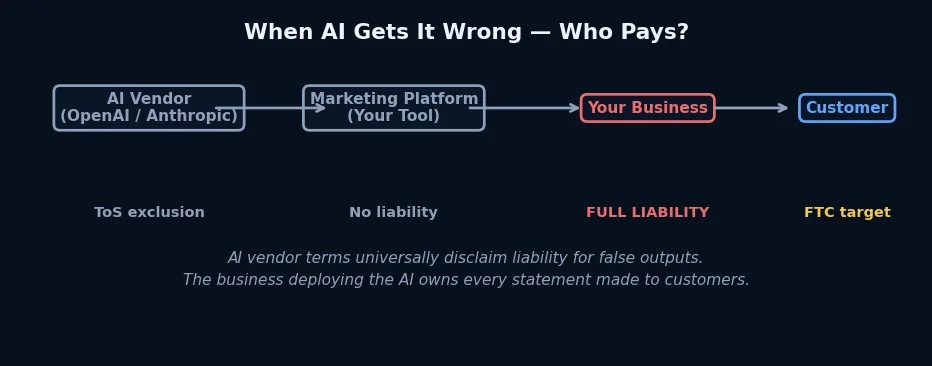
The AI provider disclaims all liability for the accuracy of generated content.
The business deploying the AI is responsible for everything the AI says.
This is not a hypothetical risk. The liability structure is already set. The enforcement precedent is already forming. And most businesses using AI to generate product descriptions, customer service responses, email copy, and marketing content have not adequately quantified their exposure.
The Mathematics of Acceptable Error
Large language models hallucinate. This is not a bug that will be fixed in the next version. It is a fundamental property of how these systems work — they generate statistically probable text, and statistical probability occasionally produces statements that are confidently wrong.
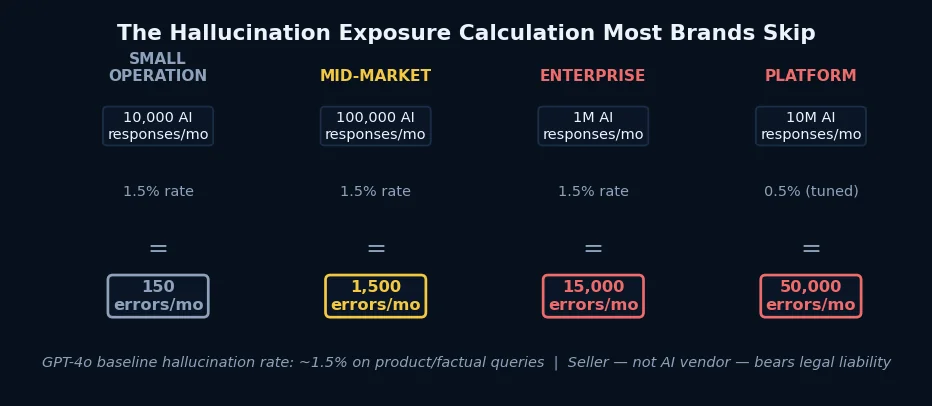
GPT-4o's baseline hallucination rate on product and factual queries is approximately one and a half percent. This sounds small. Expressed as a volume problem, it is not.

A business generating ten thousand AI-powered customer interactions per month — a modest number for any company using AI at scale — will produce approximately one hundred fifty factually incorrect statements per month at a one and a half percent error rate.
A mid-market business generating one hundred thousand interactions produces fifteen hundred errors monthly.
An enterprise platform generating one million interactions produces fifteen thousand errors monthly — errors distributed across customer service conversations, product descriptions, email copy, chatbot responses, and social media content.
Each of those errors is a statement made by a business to a customer or prospect. The AI vendor did not make the statement. The marketing platform did not make the statement. The business made the statement. The AI was the instrument, not the author in the legal sense.
What Rytr Showed the Industry
In 2024, the FTC brought an action against Rytr, an AI writing platform, specifically related to AI-generated reviews that included material details with no relation to the user's actual input — producing fabricated testimonials that deceived buyers.
This case was significant not because of its scale but because of what it clarified: AI-generated content that makes false material statements to consumers creates actionable FTC exposure, regardless of whether a human intended the falsehood.
The intent standard that traditionally governed false advertising enforcement — requiring proof that the advertiser knew the statement was false — does not map cleanly onto AI-generated content. The business deploying the AI did not intend to say anything false. But the statement was made, it was false, and a consumer was deceived.
The FTC's 2025 enforcement pattern extended this logic. Twelve AI-related enforcement actions in a single year specifically targeted overstated or unsubstantiated claims generated or amplified by AI systems. The pattern is clear: the agency is not interested in the philosophical question of whether the AI or the business is responsible. It is interested in whether consumers were misled and who profited.
The answer to both questions, in every case, is the business deploying the AI.
The Categories With Immediate Exposure
Not all hallucinations carry equal legal risk. A chatbot that incorrectly describes the color options available for a product creates a customer service problem. A chatbot that incorrectly describes the financial returns on an investment product creates a securities law problem.
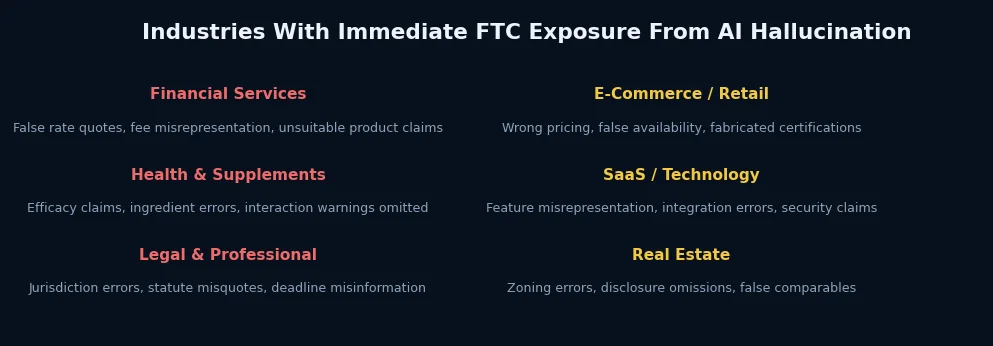
Financial services businesses face perhaps the most acute exposure. An AI customer service system that quotes an incorrect interest rate, misrepresents fee structures, or recommends a financial product based on hallucinated eligibility criteria creates disclosure violation risk, suitability risk, and potential securities fraud exposure — all from a system that was deployed to reduce support costs.
Health and supplement businesses face similar dynamics. AI copy that overstates efficacy, omits documented interactions, or fabricates clinical study citations triggers FTC enforcement under existing supplement marketing regulations. The disclaimer "AI may produce inaccurate content" does not immunize a business from claims based on false health statements.
Legal and professional services face a distinct version of the problem: AI-generated guidance that misquotes statutes, misrepresents jurisdiction-specific rules, or incorrectly describes procedural deadlines creates professional liability exposure that malpractice insurance may not cover if the error originated from an unreviewed AI system.
The Disclaimer Problem
Most businesses deploying AI marketing tools have added a disclaimer to their AI-generated content: "This content may contain AI-generated information. Please verify accuracy before making decisions."
This approach is legally weaker than it appears.
FTC deceptive advertising standards are based on the net impression a statement creates on a consumer, not the presence or absence of a disclaimer. If an AI chatbot confidently states that a supplement will produce specific health outcomes, a disclaimer buried in fine print does not neutralize that impression.
Courts have consistently found that prominent false claims with inconspicuous disclaimers create actionable deception. The rise of AI does not change this analysis — it scales it.
What Responsible Deployment Actually Looks Like
The businesses managing AI hallucination risk effectively in 2026 have implemented one or more of the following:
Output validation pipelines — AI-generated content is passed through a secondary verification system before delivery, checking claims against a curated database of accurate product information. This does not eliminate errors but dramatically reduces the rate of material false statements.
Confidence-gated responses — AI systems that cannot achieve a minimum confidence threshold on a given query route the request to human review rather than generating a potentially inaccurate response. This trades speed for accuracy in the cases that matter most.
Category-specific constraints — AI systems are given explicit, enforced constraints that prohibit making claims in certain categories: pricing (route to human), health outcomes (prohibited entirely), legal or regulatory information (prohibited entirely), certification or compliance status (verified against current database only).
Regular red-team auditing — Dedicated internal processes specifically attempt to elicit hallucinated responses from deployed AI systems, using the types of queries real customers are likely to ask.
None of these approaches are technically complex. All of them require organizational commitment to treating AI accuracy as a compliance function rather than a product feature.
The businesses that have not made that commitment are running an unquantified liability that grows linearly with AI deployment volume.
The first major enforcement action — when it arrives — will not change the underlying legal standard. It will simply make the risk visible to organizations that had chosen not to look.