
At some point in 2023, a company called 11x.ai sent its first AI-generated sales outreach email.
The email appeared to come from a person. It had a name. It had a professional-sounding job title. It referenced the recipient's company in a way that felt researched. It asked for a meeting.
It was not written by a person. It was not sent by a person. The "person" whose name appeared in the email did not exist.
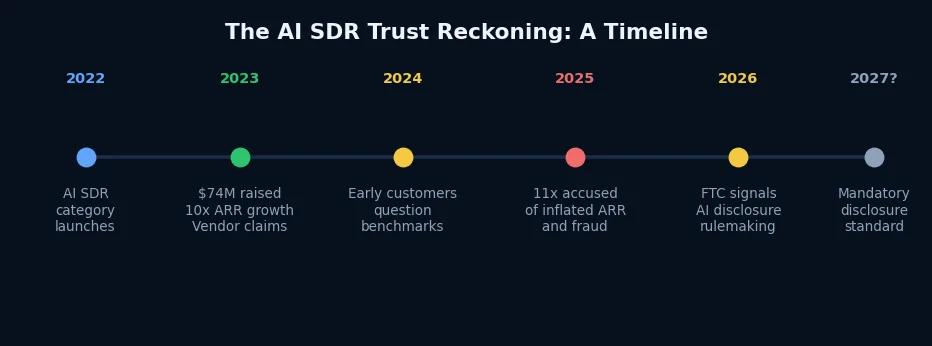
11x raised seventy-four million dollars. It reportedly hit ten million dollars in annualized recurring revenue in under two years. It was one of the fastest-growing startups in the history of AI sales automation.
And then the allegations began: that the ARR figures were constructed by counting customers who had exercised break clauses as if their contracts would run to full term. That the performance benchmarks used to sell the product did not reflect the actual outcomes customers were experiencing. That the fundamental value proposition — an AI that could conduct sales outreach indistinguishably from a human — depended on a form of deception that neither regulators nor enterprise procurement teams had fully reckoned with.
The 11x story is not primarily about one company. It is a preview of a reckoning that is arriving across the AI sales and marketing automation industry.
What AI SDRs Actually Do
The premise is elegant. Sales development representatives — SDRs — are expensive, high-turnover, low-leverage roles. Their job is to send outreach messages, follow up persistently, and book meetings for account executives. The work is repetitive. The average SDR tenure is fourteen months before burnout or departure.
AI SDR platforms replace this function with software. The systems send outreach at scale — some platforms advertise thousands of personalized messages per day — follow up automatically, handle basic objection responses, and route qualified prospects to human closers.

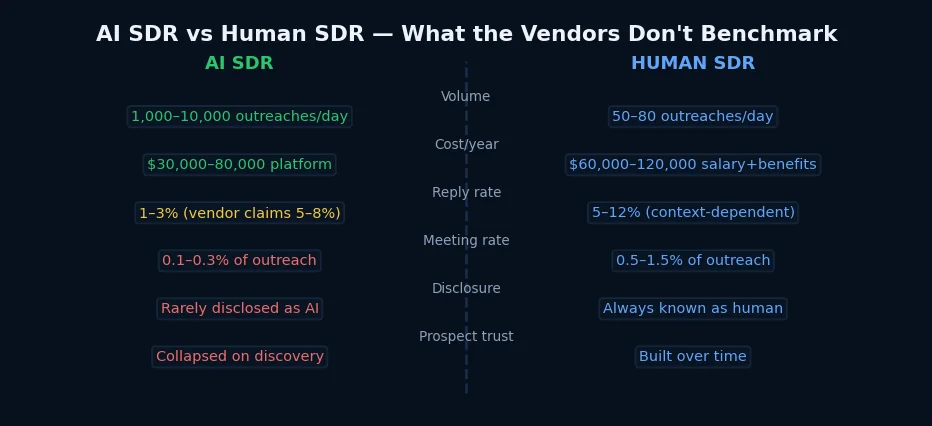
The economics appear compelling on paper. An AI SDR platform costs thirty to eighty thousand dollars annually. A human SDR costs sixty to one hundred twenty thousand dollars in fully loaded compensation. Volume is dramatically higher. Operational consistency is better.
What the vendor benchmarks consistently fail to show: the meeting rate per outreach contact, normalized by response rate and pipeline quality.
Human SDRs at quota typically book meetings at zero point five to one and a half percent of outreach contacts — not glamorous, but these meetings convert at higher rates because the prospect engaged with a human who exercised judgment about fit.
AI SDR platforms routinely claim five to eight percent reply rates in marketing materials. The reply rate includes every response, including "please remove me from your list" and "who is this?" The meeting rate from those replies — the number that actually matters for pipeline — is typically in the zero point one to zero point three percent range. And the downstream conversion quality of AI-sourced meetings is systematically lower than human-sourced meetings in most documented implementations.
The gap between marketed metrics and actual outcomes is the 11x story in miniature. Replicated across dozens of vendors.
The Disclosure Problem Nobody Has Resolved
There is a question at the center of AI SDR that the industry has not answered, and regulators are beginning to force.
Is it legal to send automated sales outreach that appears to come from a specific human being who does not exist?
The FTC's current framework on deceptive practices suggests the answer is almost certainly no — if the deception is material to the consumer's decision to engage. A prospect who would not have replied to an email from an AI system, but who did reply because they believed they were corresponding with a human, was deceived in a way that influenced their behavior.
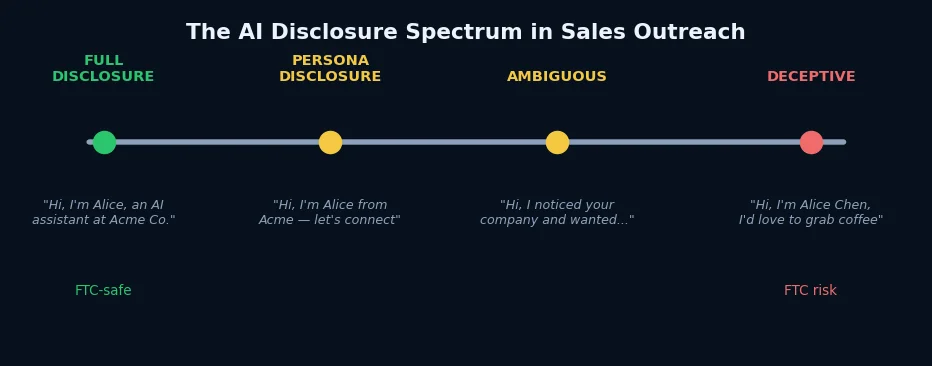
The counterargument — that no one "deceives" a prospect by using AI to draft an email — has legal merit in some contexts. Using AI to write copy that a human then sends under their name is standard practice and not inherently deceptive.
The specific problem with AI SDR platforms is different: a message from a persona that does not exist, claiming to be a person with a name and a role, is categorically different from a human using AI assistance.
The FTC's 2025 enforcement pattern included guidance that automated commercial communications must clearly identify their automated nature in contexts where that fact would be material to the recipient. Business-to-business outreach from AI systems pretending to be human employees is one of the clearest examples of material automated communication.
The rulemaking signal for 2026 is a mandatory disclosure standard for AI-originated commercial outreach. When it arrives, the entire business model of platforms built on human-seeming AI personas faces a structural challenge.
What Actually Converts
The businesses using AI in sales outreach that are generating genuine pipeline growth in 2026 are not using AI to replace human salespeople. They are using AI to make human salespeople dramatically more productive.
The pattern that works: AI handles research, account enrichment, signal identification, and draft generation. A human SDR reviews, personalizes, and sends from their actual name and identity. AI handles the scheduling and follow-up logistics. The human handles the meeting.
In this model, a good SDR can work five to ten times the number of accounts they could manage manually, while maintaining the authenticity that converts prospects into customers.
The AI is a force multiplier, not a replacement. And every communication is accurately attributed to the human who sent it.
This is not the product that raised seventy-four million dollars. It does not have the narrative simplicity of "replace your SDR team with software." It requires investing in good salespeople and making them better.
But it produces pipeline that converts. It produces relationships that survive the discovery that AI was involved. And it produces an outreach program that will survive the regulatory environment that is already forming.
The Trust Asymmetry
There is a fundamental asymmetry in AI sales outreach that vendors systematically underweight.
When a prospect does not know they are talking to an AI, their engagement is based on a false premise. When they discover the AI — and they increasingly do, either through the language patterns, the follow-up timing, or explicit disclosure — the trust equation inverts completely.
A prospect who felt deceived does not just decline to buy. They warn colleagues. They post about the experience. They associate the brand — not the tool — with the deception.
The reputational cost of an exposed AI impersonation is not priced into vendor ROI models. It is not tracked in platform analytics. It is absorbed entirely by the business that deployed the system.
The 11x story crystallized this risk at the company level: inflated metrics, misrepresented outcomes, and a product built on a questionable premise collectively destroyed the trust that seventy-four million dollars of funding had built.
The same story is playing out at smaller scale across the industry, one burned prospect at a time.
The businesses building sustainable AI-augmented sales motion are the ones asking not "how much can AI replace?" but "what does AI make possible that preserves the human relationship at the moment it matters?"
That question has a different answer. And a much better long-term outcome.