
There is a version of AI-powered SMS marketing that is genuinely transformative.
Imagine a system that knows a customer browsed your pricing page three times, sent them a personalized text that acknowledged exactly what they looked at, answered their question in real time, and closed the sale — all without a human involved, all over a medium that gets read within three minutes of delivery ninety-eight percent of the time.
That product exists. It works. The reply rates for conversational AI SMS — thirty-five to forty-five percent — are roughly ten times higher than traditional batch-and-blast campaigns.
And most businesses cannot legally use it the way the vendors are selling it.
The Regulatory Wall That Arrived Quietly
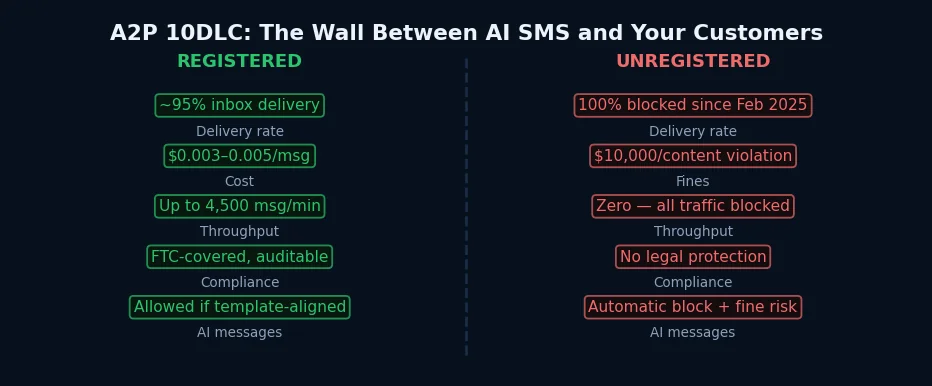
On February 1, 2025, US wireless carriers stopped throttling unregistered commercial SMS traffic.
They started blocking it entirely.
This is not a compliance nuance. It is a hard wall. Any business sending automated SMS messages from a US local phone number without completing Application-to-Person 10-Digit Long Code registration — known as A2P 10DLC — now has one hundred percent of those messages blocked before delivery. Not delayed. Not filtered. Blocked.

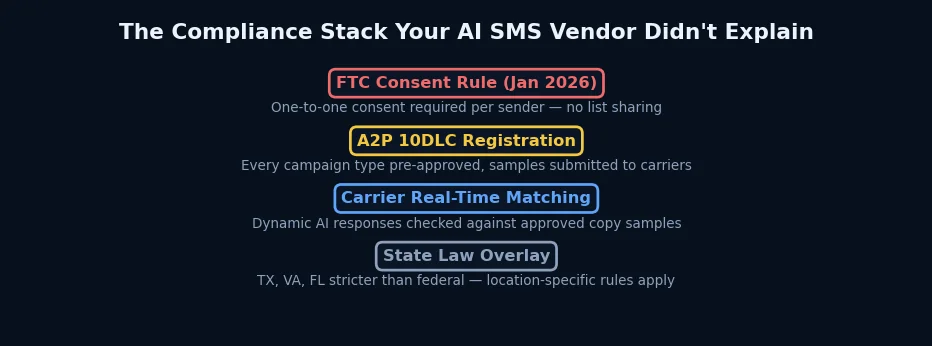
The FTC consent rule that took effect January 27, 2026 added another layer: explicit, individual consent per sender. The broad consent language that most marketing platforms built their list-growth strategies around — "by signing up you agree to receive marketing messages from us and our partners" — no longer qualifies. Each brand requires its own consent, obtained individually.
T-Mobile's enforcement schedule is not abstract. The fine structure is ten thousand dollars per content violation and one thousand dollars per evasion incident. Evasion includes technical workarounds — rotating numbers, using short codes improperly, or structuring campaigns to avoid registration thresholds.
Most businesses using AI SMS platforms were not adequately informed of any of this.
Why AI Makes Compliance Harder, Not Easier
The fundamental promise of conversational AI SMS is dynamic, personalized responses. The system reads the customer's message, understands context, and generates a reply that is relevant to that specific conversation.
This is exactly what A2P 10DLC compliance makes structurally difficult.
The registration system works by requiring businesses to submit approved campaign descriptions and message samples to The Campaign Registry — the industry body that coordinates 10DLC compliance across carriers. Carriers then use those samples to verify that actual messages align with registered campaigns.
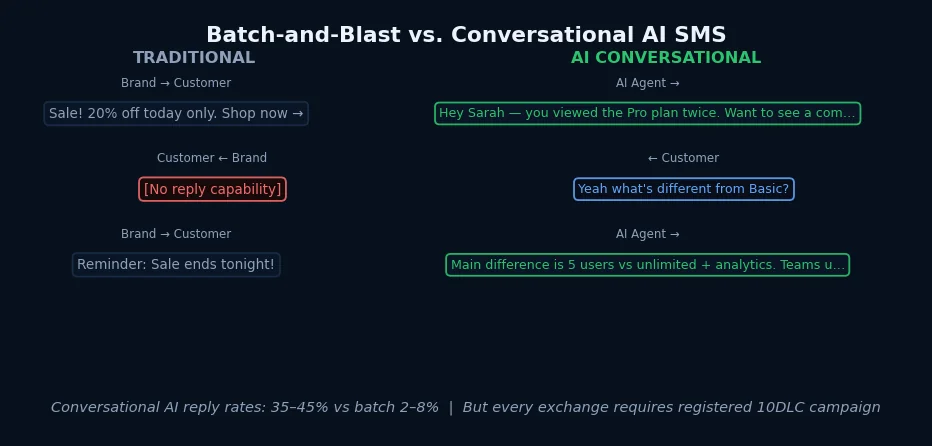
Static batch messages are easy to register. The sample is the message. What you submit is what you send.
AI-generated conversational responses are not static. By definition, they vary based on the conversation. The system might send one thousand different responses to one thousand different customer queries — all of which need to align with the pre-approved campaign samples on file with The Campaign Registry.
This creates a compliance paradox: the more sophisticated and personalized the AI SMS system, the harder it is to register compliantly.
Vendors have developed partial solutions. Some maintain libraries of pre-approved response templates from which the AI selects. Some use AI to generate responses within tight constraints that keep content within approved parameters. Some simply do not disclose to customers that their "dynamic" AI responses are actually constrained by compliance requirements — which means the dynamic personalization they sell does not exist the way it is marketed.
The Consent Problem
The FTC's one-to-one consent requirement is not just a compliance checkbox. It is a fundamental restructuring of how SMS marketing lists can be built and used.
Most SMS marketing lists were built under broad consent frameworks. A customer provided their phone number in exchange for a discount code, checked a box agreeing to marketing communications, and was added to a list that might be used for multiple campaigns across multiple product lines.
Under the 2026 rules, that consent does not transfer. The customer consented to receive messages about the specific offer they were signing up for. Using that number for a different campaign — even from the same brand — requires fresh consent.
For businesses using AI SMS to expand their outreach, this means retroactive list auditing. Every number on an existing list needs to be evaluated for whether the original consent meets the new standard. In practice, most lists built before 2024 do not.
The legal exposure is real. TCPA lawsuits — private rights of action for unsolicited text messages — routinely settle for hundreds of dollars per message. A business with one hundred thousand contacts who lack proper consent under the new standard faces potential liability that dwarfs the revenue the SMS channel generates.
The State Law Layer Nobody Mentioned
Federal regulation is the floor, not the ceiling.
Texas, Virginia, and Florida have enacted state-level privacy and marketing regulations that are materially stricter than federal requirements on several dimensions relevant to AI SMS.
Texas requires opt-out processing within ten days versus the federal standard. Virginia's Consumer Data Protection Act creates additional consent and data minimization requirements for AI systems that make automated decisions about consumers. Florida's Digital Bill of Rights adds transparency requirements for AI-driven communication that most SMS platforms have not addressed.
For businesses operating nationally, compliance means satisfying the strictest applicable state law — which in practice means building to Texas, Virginia, and Florida standards for the entire list.
This is not information that most AI SMS vendors surface prominently in their sales process.
What Actually Works
None of this means AI SMS is a bad investment. The channel's fundamental economics — near-universal read rates, high engagement, direct attribution — remain compelling.
The businesses succeeding with AI conversational SMS in 2026 have done three things differently.
First, they rebuilt consent collection from scratch — using active, explicit, campaign-specific opt-in flows rather than bundled consent language buried in terms of service.
Second, they registered multiple 10DLC campaigns by use case rather than attempting to use a single broad registration for all AI-driven communications.
Third, they accepted that true dynamic AI generation requires human review loops for message categories that approach the boundaries of approved campaign parameters — preserving the speed advantage of AI while maintaining compliance.
The vendors who are winning are the ones being honest about these constraints and building compliance into the product architecture, rather than the ones selling maximum flexibility without disclosing the regulatory reality.
The businesses being sold "unlimited dynamic AI SMS" without a clear compliance conversation should ask a simple question: what happens to my business when T-Mobile's enforcement catches up to my campaigns?
The answer, at ten thousand dollars per violation, is not abstract.